Terri’s Blog
Here you will find musings about art, gardening, travel, and whatever else comes to mind when I’m in a writing mood. Many of these entries contain info about my artistic processes and how other artists have inspired me to try new techniques. Same goes for gardening. I’m always trying and learning new things and finding joy in these discoveries. Check out some of my posts below and enjoy!
More About Mushrooms (and Other Things)
Not sure what kind of mushrooms you were thinking of reading that title, but I’m talking about these kind of mushrooms, the kind that pop up rather spectacularly when you finally organize and clear out some ground space in your toolshed. What a wonderful and unexpected sight for all of us to come across while putting away our tools! I also have to confess I enjoyed drawing the tools as much as the mushrooms.
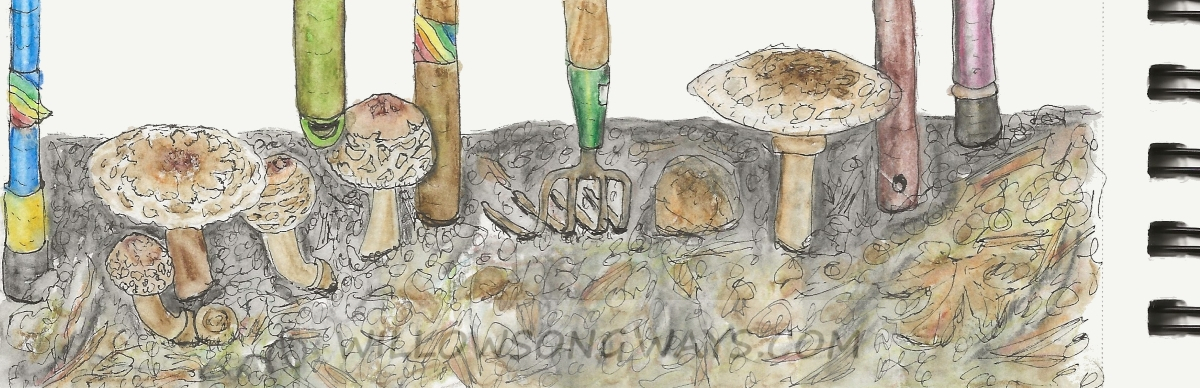
From doing just an image search, I believe these to be either Parasol (Macrolepiota procera, good for eating), Shaggy Parasol (Lepiota rachodes, edible if cooked well, but can cause stomach upset for some people), or False/Green-spored Parasol (Chlorophyllum molybdites, poisonous!). We just let them be and have not done any cuts, spore tests, or other such things to seriously try to identify them. Given the range of possibilities, this sounds like the safest answer.
I am always a big fan of plants that pop up in inhospitable or unexpected places. For example, if you hike up the Beacon Rock trail in the Columbia River Gorge (highly recommend!), you will see all sorts of life growing in the cracks and crevices on its sheer cliffs. And anywhere you find decaying wood, you are likely to find one life ended slowly transforming into all sorts of new lives.
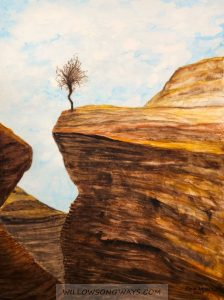
Back in 2025, I was particularly taken with this little tree growing out of the rock somewhere in Utah canyon country and had to paint it. I call this one “Finding a Way”.
Sometimes nature can be creative, tenacious, and resilient. Seeing examples of this fills me with joy and hope.
Magical Shadows
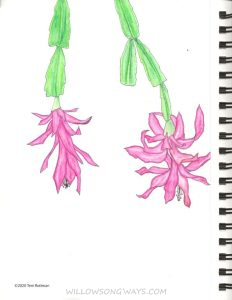
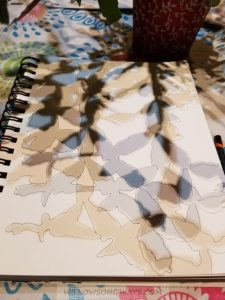
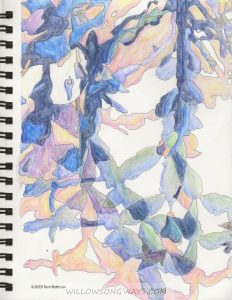
One day I noticed the sun filtering in through the window of our little front room creating a warm, cozy space and lighting up the Christmas cactus which was in full bloom. I couldn’t resist the invitation and quickly grabbed my journaling supplies and settled down in front of it. Initially drawn to the dazzling pink flowers, my attention quickly shifted to the cast shadows on the surface below. Light coming in from multiple sources was creating all sorts of intriguing patterns and colors, so I snapped some photos and began to sketch. I drew the flowers as well, but in the end, it was the shadows I most enjoyed capturing.
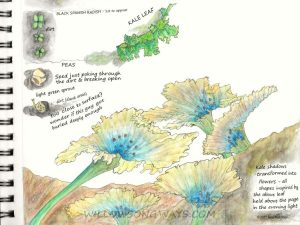
Another day I was out in the vegetable garden journaling about some peas and radishes that were just coming up, but once again it was the frilly-edged shadows from nearby kale plants teasing at the corners of my notebook that really caught my eye. When I finished with the peas and radishes, I found the ideal position for my notebook and traced the kale shadows to fill out the bottom of my page. Sitting back to see what these shapes looked like, they immediately transformed into flowers in my mind. Adding some additional lines and color, they became the highlight of the page.
Autumn leaves make great shadows too. They are one of my favorite things to draw, but it can be difficult to get them to stay in one position if you are sitting on the couch. My solution? I stuck the stems into the spiral holes of my notebook. Once again, my attention was diverted from my subject to its shadows. I ended up drawing these instead but colored them in as if they were the leaves.
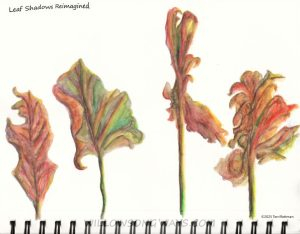
One of the things I love most about nature journaling is that it almost always takes you some place unexpected. I hope you are inspired to find some magical shadows of your own.
Spider Webs are Complicated (and Amazing)!
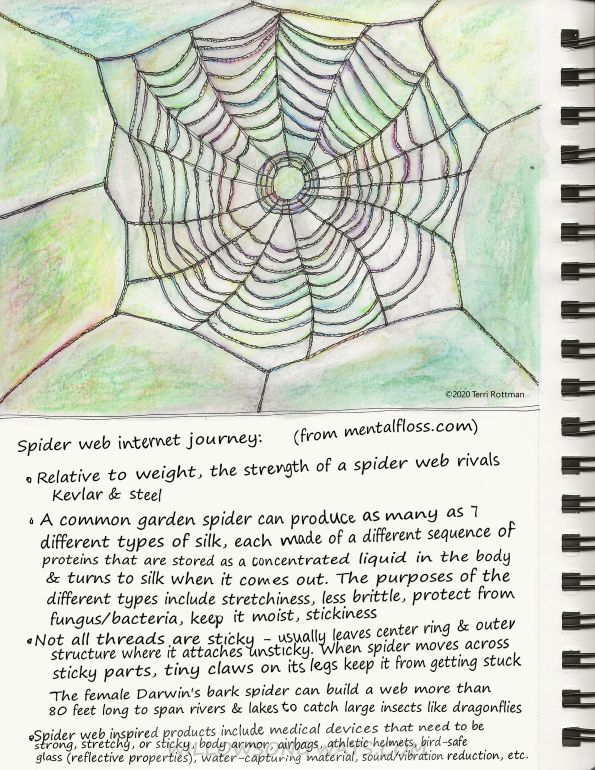
This drawing is from a nature journal entry I did back in November of 2020 when I saw this amazing spider web in my grapevines. It was backlit by the sun such that all the threads sparkled with a rainbow of colors, and I felt compelled to do a drawing and find out more about it.
After a little research, I learned that spiderwebs come in several general patterns, and the one I saw is called an orb web. It has an inner empty circle followed by a small spiral followed by another small gap. After this is a much larger spiral that constitutes most of the rest of the web. The large spiral does not go to the very edge of the web, however. Instead, there is an outer ring that a few threads from the main part of the web hook up to, and this is what attaches the web to its surroundings. The other thing I didn’t realize, that of course makes total sense, is that the threads on both the top and the bottom side curve downwards as if pulled by gravity (duh). You always see them drawn with the threads all curving inward, but this is not the case in the real world.
I also learned that this type of web is often repaired or rebuilt daily — that’s a lot of work for the little spider! Imagine having to rebuild your house every day. The rainbow effect comes from little sticky droplets that dot the web and are used to catch bugs.
Per my journal entry, I never thought it would take me so many tries to draw a spider web. I spent over an hour just trying to make a simple sketch that looked right and still wasn’t totally happy with the end result. Unfortunately, I didn’t take a picture of it, and the web was gone the next day, so this was the only drawing I got. Funny that while I am writing this, I see a spider climbing up the wall!
Neurographic Perfoliate Alexander – Now That’s a Mouthful!
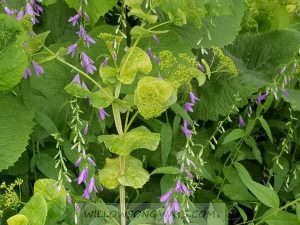
One summer several years ago, my family visited Bellevue, WA to attend a soccer tournament. While we were there, we had a chance to explore the beautiful Bellevue Botanical Garden. If you are ever in the area, this garden is definitely worth a visit.
I took lots of plant pictures, and one of my favorites has long been what I believe to be Perfoliate Alexander (Smyrnium perfoliatum) surrounded by some little bell-shaped purple flowers. For years I’ve had a printout of this picture floating around in my art inspiration folder. I once did a paper collage version of it that did not go well, but I still loved the photo and kept it in my stack for future work.
As I mentioned in a previous post, I have been experimenting with incorporating neurographic art techniques into some of my work. Hmm, I thought, maybe using this would be the perfect solution for doing something with this photo. I first did a detailed pencil sketch of the main plant and went over this with my .005 Micron pen. Then I added a loose sketch of the purple flowers in pencil and returned to my pen to draw in a whole series of mostly random lines from the edges of the page to the edges of my central drawing, following the purple flower sketch lines whenever I intersected them. I went back over these lines again to fatten them up a little and add curves to all the crossing points. Then I took my watercolor pencils and colored it all in. The result isn’t perfect but makes a nice journal entry and gives me a new reference to use for doing a full painting of it in the future. This page makes me smile whenever I look at it as it was both a pleasure to create and brings back memories of that enjoyable trip.
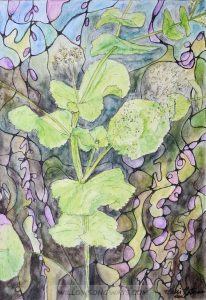
And if you are a plant geek like me, an internet search that included iNaturalist, Kew Gardens, and pfaf.org sites yielded a few interesting facts about this plant.
- It is a biennial that is part of the carrot family (Apiaceae)
- Its native range is eastern/central Europe to the Mediterranean and Caucusus
- It blooms June–August and its seeds ripen July–September
- It is self-fertile and likes moist, well-drained soil and full sun but can tolerate partial shade
- The leaves and young shoots and stems are all edible either cooked or raw in salads. It is said to have a strong celery flavor and the seedlings can be used as a parsley substitute. The root can also be cooked and used in soups and the spicy seeds can be used like pepper.
Who knew? I wish I could taste it. Aha! More searching just revealed that one of the seed companies I regularly order from has a different variety of Alexander (aka Black Lovage, also edible) that I might have to try someday.
From Shower Stall to Show Entry
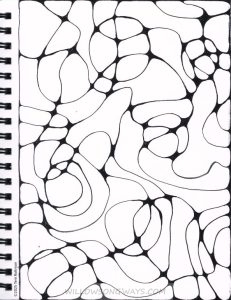
Recently I read a newsletter from Jill Jeffers Goodell (Glastonbury Studios), a wonderful teacher I have taken a few classes from, where she talked about taking up neurographic art (aka Neurographica). This art form was developed by Russian psychologist Pavel Pskarev and the basic idea is to let yourself go and draw a series of random flowing lines. Wherever they intersect each other, you smooth out any sharp corners which creates pleasing neuron-like lines and shapes. You can then color in the resulting shapes if you like. She warned her readers that it could be addictive, and she was right! It is a very enjoyable process.
The first one I did I liked all by itself and didn’t add any color. I later tried playing with adding additional lines paralleling the originals in spots and leaving some holes in some of the intersections. I was not as happy with that one, but turned a certain way it looked like a squirrel holding a nut — maybe I will try coloring it in at some point. The thing that I’ve found most interesting with this technique has been combining its randomness with a purposeful drawing to create something unique and special.
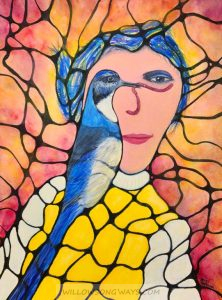
This is where the shower stall part comes in. A couple of years ago my mom had the idea to do something creative with these interesting marble-like patterns on the wall of her shower. We took some pictures, printed them out, and let our artistic processes take us where they wanted to go. For me, I immediately saw various animals and figures in these patterns and began drawing over the printouts to flesh out what I was seeing. I then took pictures of my draw overs, ran them through various filters on my phone, and came up with a series of fun pictures. I have for a long time wanted to take some of these further and turn them into actual paintings, particularly this “bird lady” one but wasn’t sure what to do for a background. Maybe using this new technique would be the answer.
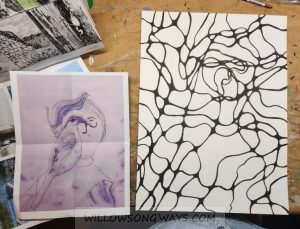
I did a sketch of my reference photo on a piece of watercolor paper and then added a whole series of random lines in black ink, joining up with the lines of my sketch in some places. I then smoothed out all the intersections and added some initial color using watercolor paints. From there I used a combination of acrylic gouache and acrylic to add additional detail to the bird and the woman, covering over and/or moving some of the black lines as needed. As a final step I went back to watercolor and made the background colors even more dramatic. Working on this was a lot of fun and it is now one of my favorite pieces. Besides liking the painting, I also really like the crazy story of how it came to be, something that is in itself full of the same combination of randomness and precision found in the end result.
A Magical Visit to Port Townsend
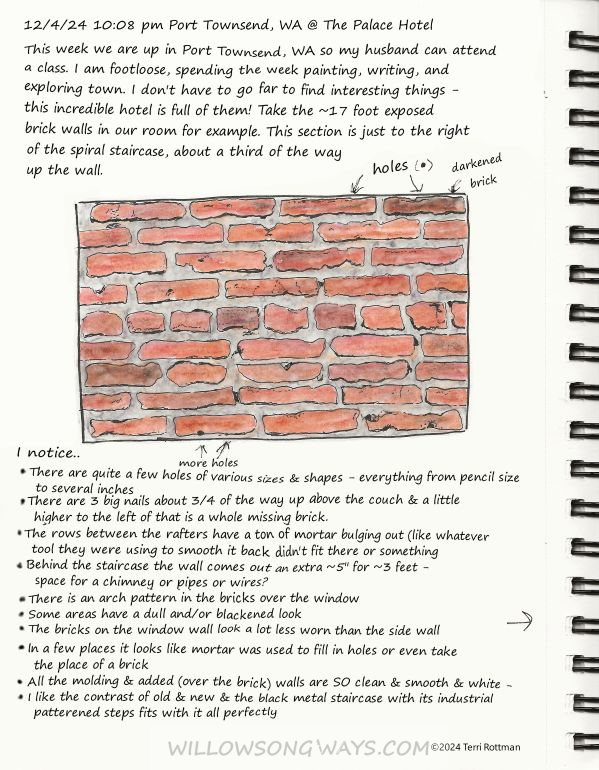
Last December I had the chance to spend a week painting, writing, and exploring in Port Townsend, WA. We stayed on the third floor of a grand old hotel looking out across Puget Sound to Whidbey Island. I didn’t have to go far looking for interesting subjects to draw or write about, starting with the walls in our room!
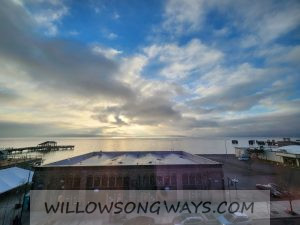
The view out our window was something I never tired of. I could watch the people browsing shops on the sidewalk below, the boats coming and going down at the ferry landing, and the birds out on the water and pilings. And then there was the light, ah the light. In the evening the sky became a mix of pink and gold and pale blue, sometimes dotted with a few tiny clouds or spanned by long lines of fog. The water reflected the sky, light blue to pink to gold and then light blue again, broken in places by the rippling dark reflections of the old buildings. The land in between turned a deep blue gray. It was such magic. An artist could spend a lifetime just capturing that same scene as the light transformed it throughout the day.
Inside, the hotel was so quiet, almost otherworldly. All the grand spaces seemed meant to be filled with voices and laughter and movement, yet when I walked through them, I rarely saw another person. One day I passed by one of the large common areas, a room filled with books, a fireplace, and a Christmas tree. They had music from another era playing, the singer’s achingly beautiful voice filling the room and bringing back another time. You could almost see her audience lounging on the sofa or mingling along the shelves, drinks in hand, all eyes turned her way. Just then, an older couple appeared, turning the corner at the top of the wide main staircase. They stopped for a moment to take in the scene, transfixed, just as I was. We all stood frozen for a long moment, watching silently as the scene played out in our imaginations, until eventually the spell was broken, and we smiled as we passed by one another and went on our way. Perhaps someday I will try to paint that moment, but for now words will have to do.
Instead, I spent the week painting a much more down-to-earth subject — tomatoes. The high ceilings and expansive view made for a great setting to let creativity flow, and for me that meant working with lots of bright colors. These two paintings started as rather unexciting watercolors of tomatoes that I marbled over back in the summer to try and spice them up. During the week in Port Townsend, I added to the marbling, using a mix of watercolor and acrylic, and turned them back into tomatoes once again. The painting titles are courtesy of my critique group. Enjoy!
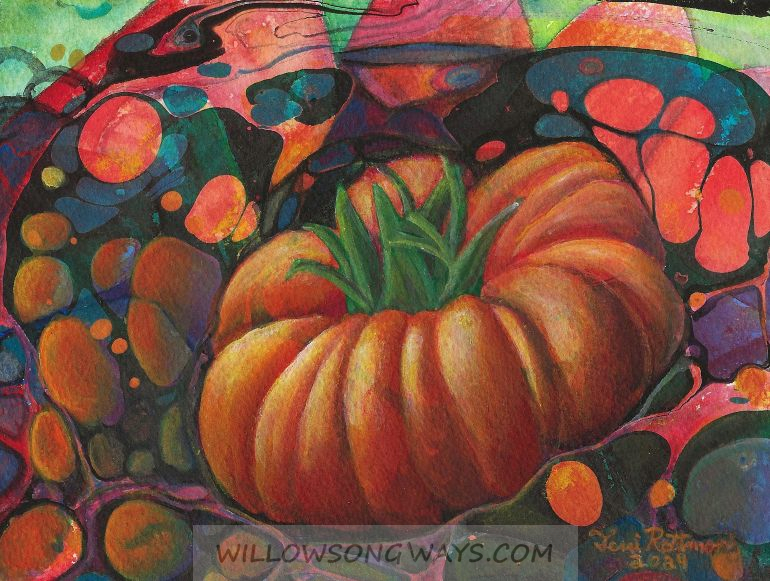
Psychedelic Tomato, 2024, Acrylic & Watercolor, 8 x 6
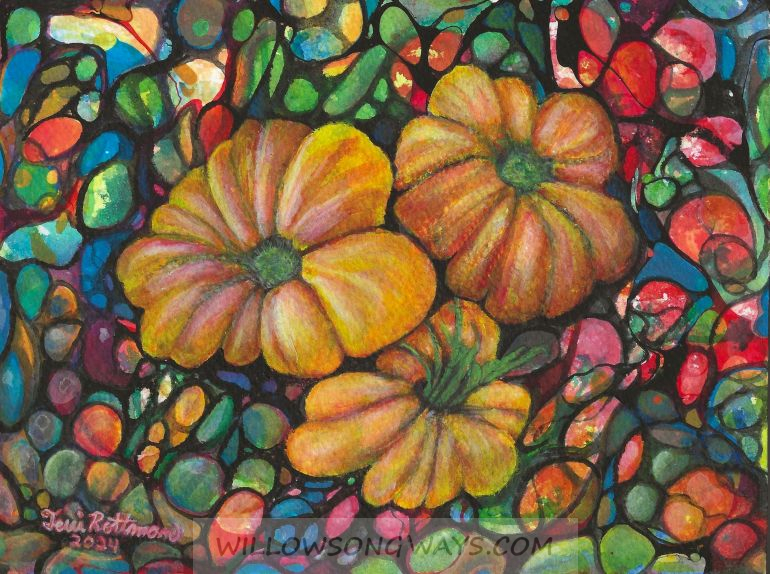
Tomato Trio, 2024, Acrylic & Watercolor, 8 x 6
Mushroom Meeting in the Bean Patch
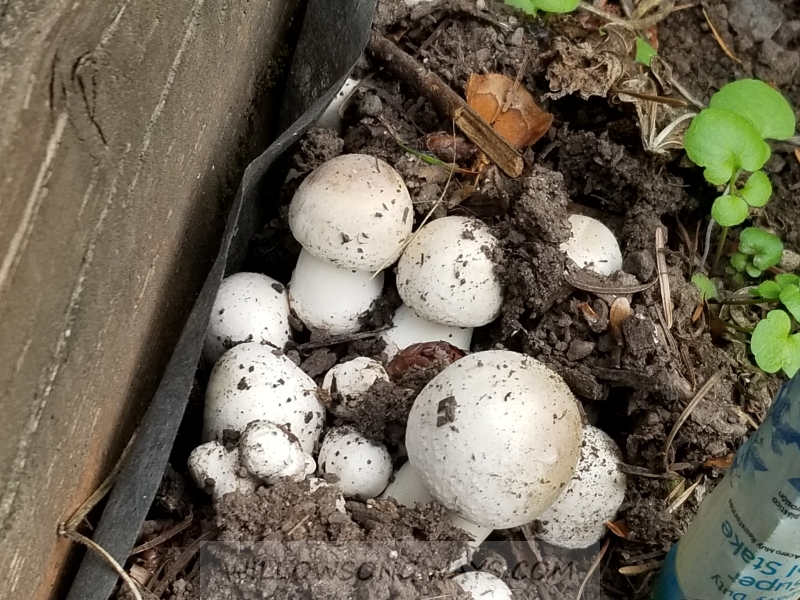
One October evening, I wandered through the garden doing some late-season harvesting. As I shifted the leaves on my bean plants, I noticed this little cluster of mushrooms growing next to the edge of the bed. I believe these are yellow stainers which are not edible but can be quite cute in their early stages. I took a few pictures and later did a drawing of them in my journal.
It looked as if they were all clustered together having a meeting, something I have a lot of experience with from my corporate career days. We had so many meetings that an “Effective Meetings” class was required training for all employees. I reminisced a bit and thought about how meetings could run the full spectrum from boring to stressful to inspiring and energizing to laughing until your sides hurt. For all its messiness, spending time with co-workers, friends, and family has always given me life’s greatest moments.
Anyway, I drew the mushrooms looking pretty much as they did in my photo, and next to this I did a second version, imagining what the meeting version might look like. Here is a little story to go with it:
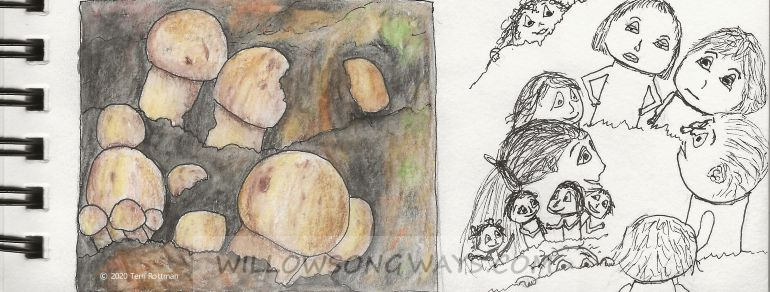
Nestled in the corner of the vegetable bed, hiding beneath the beans, the mushroom family was having a meeting. Smoke from the neighbor’s chimney wafted through the garden making it difficult to see the sky. Mushroom #1 droned on in her know-it-all tone. Mushroom #2 next to her had a pained expression on her face. Mushroom #3 thought “she is so full of beans” (which was appropriate given their location). Mushroom #4’s attention was elsewhere, her brood of laughing, screeching children running chaotically around her. Mushroom #5 did his best to ignore them all and listen attentively. He was the only one in the family that hung on Mushroom # 1’s every word. Mushroom #6 looked up and gasped as a hummingbird appeared to be flying straight toward him. The bird veered off at the last minute and hovered above mushroom number #1, drinking nectar from the bean flowers. When it had finished, it hovered for a moment longer and looked down at mushroom # 1 as if listening. Its little body gave the smallest of movements, leaving a splat on mushroom #1’s forehead. Or perhaps this was just wishful thinking on the part of Mushroom #2.